
About Us
Ashrams
Pakistan
Sant Satguru
Events
Satguru Warsi Utsavs
Satguru Janam Utsavs
Special Ashram Observances
Dharmic Festivals
Pakistan
Satguru Warsi Utsavs
Satguru Janam Utsavs
Special Ashram Observances
Dharmic Festivals
The Sixth Light (1936–2008)
Satguru Shiv Bhajan hai, Shiv Saroop Bhagwan
Tankay pad wandan karoon, milay tan man ko aram
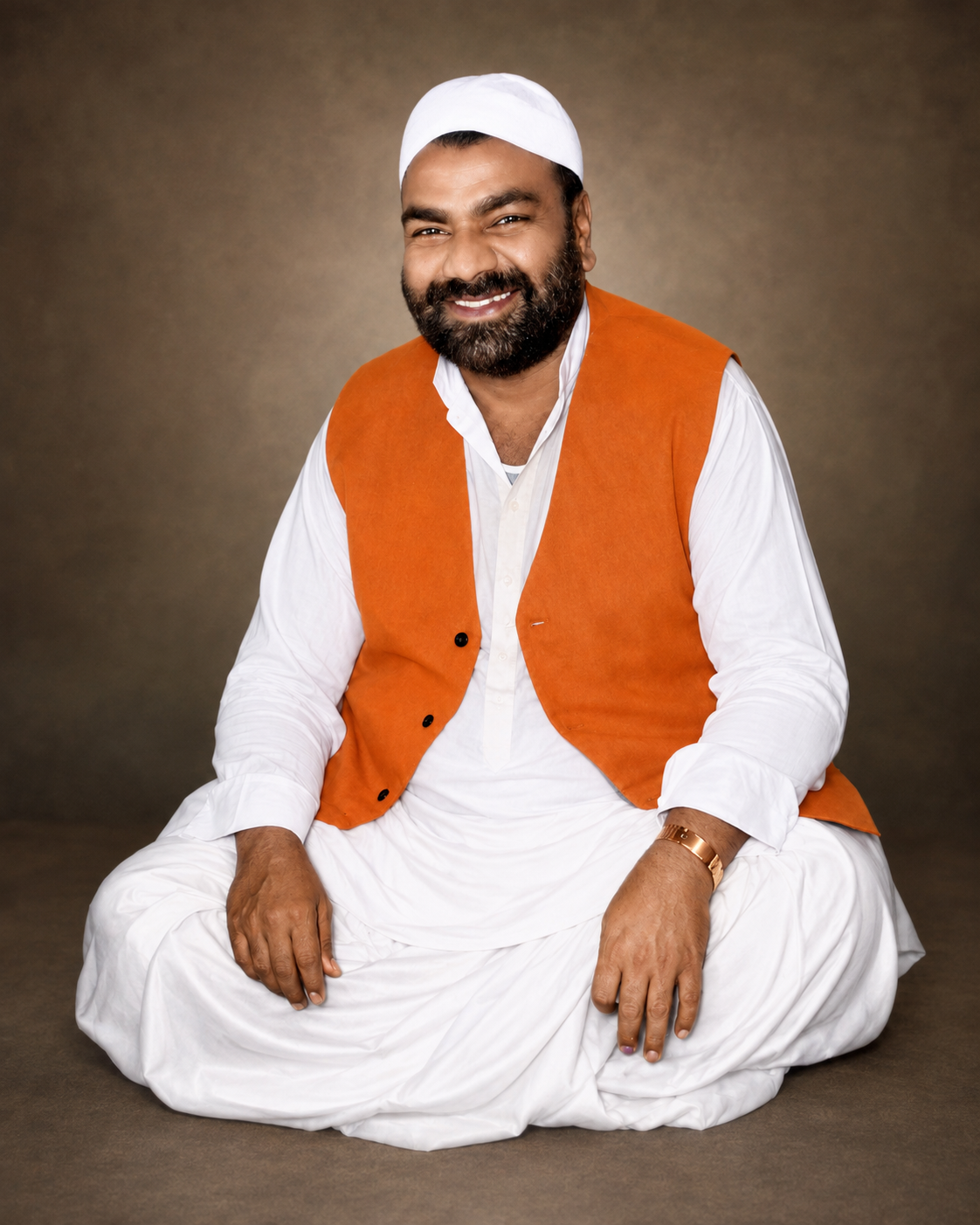
Sindh is a sacred place full of pious saints, hermits, sages, and holy people. It is the hometown for luminaries like Saami, Sachal Sarmast, Shah Abdul Latif Bhitai, Wasan Ghot, Paru Shah, Kanwar Ram, Bedil Bewas, and many more. Devotees from all over the world come to pay homage to these holy shrines and samadhis to attain bliss and peace of heart. Among these radiant souls stands Satguru Swami 108 Baba Shiv Bhajan Sahib, whose divine advent brought an ocean of grace to Samadha Ashram.
Pram Pujniye Satguru Swami 108 Baba Shiv Bhajan Sahib incarnated on Thursday, September 20, 1934 (Vikram Samvat 1991, Sanbat Tith Baras) during the daytime at Shikarpur, Sindh, Pakistan.
Centuries ago when Gautam Buddha appeared, strange phenomena were witnessed by His parents, and astrologers prophesied about Him as a divine incarnation. Those historical prophecies were repeated when Fifth Patshahi Baba Gobind Bhajan Sahib announced at the birth of Baba Shiv Bhajan Sahib: “This child is not a common child!”
On the sixth day during the naming ceremony, all family members, relatives, friends, and saints were invited for celebration. When the baby boy was brought before the saints, Baba Gobind Bhajan Sahib took the infant in his lap and folded his hands in a respectful namaskar to the baby. When some saints asked the reason for this gesture, Sain Baba revealed: “Baba Kishan Bhajan Sahib stated that in His next birth He would become the Son of Dewan Thakur Das, so that is why I have greeted Him.”
When the Brahmin astrologer checked the horoscope for naming the child, he found that this was not an ordinary child, but an enlightened soul who had taken human form. Saints named the boy Shewa Ram, and everyone present rejoiced. There was a radiant light and smile on the face of infant Shewa Ram. The astrologer understood that this child would grow up to become a saint, help mankind, and make the land holy, acknowledging the same to the mother of the child, Mata Jethi Bai.
Mata Jethi Bai and Dewan Thakur Das rejoiced, gifting heavy clothes to saints and Brahmins while distributing food and clothing to the poor and needy.
Dewan Thakur Das, the father of Shewa Ram, was a man of principle with a deep inclination toward spirituality. He visited Samadha Ashram from his youth and was fond of satsang, especially Sufiyana verses, which he sang with such devotion that tears fell from his eyes. His mother, Mata Jethi Bai, was a pious, religious soul who served everyone. Shewa Ram was the fifth and last son; unlike previous children who cried frequently during infancy, Shewa Ram remained quiet most of the time, as if continually connected to God and chanting His name in silence.
As Baba Shiv Bhajan Sahib grew, Mata Jethi Bai taught him moral and ethical stories of Guru Baba Nanak and other saints, making him learn Jap Sahib by heart. She instilled in him honesty, integrity, and right values, fulfilling her maternal duty with profound wisdom.
At the age of five, the child was admitted to school. Intelligent from the beginning, he learned and memorized lessons instantly and completed all assignments. After finishing the 5th standard, he entered New Era High School for secondary education. He admired his white shirt and white trousers uniform, and was fond of using a golden nib for his pen and a golden strap for his watch. Compassionate from childhood, he shared his pocket money with the poor and used recess to tutor classmates who struggled with mathematics. Even while completing his Matriculation examinations during his teenage years—and developing a strong command of English under his teacher, the late Kisha Ram—his spiritual destiny was already unfolding.
Right from childhood, Sain Baba rose at sunrise, washed the Thakurs, placed fresh roomals on the Guru Granth Sahib, and switched on the lights. He accompanied his mother to Samadha Ashram to pay homage and perform Seva. After school, he visited Saint Bhai Deyo Ram (a homeopathic practitioner), filled water and food in clay utensils for birds, and visited Airy Wari Darbar and Baba Santok Das Darbar to perform Seva. He was deeply fond of meditation, sitting for hours in quiet contemplation within himself.
Sain Baba surrendered Himself completely at the feet of His Satguru, Baba Gobind Bhajan Sahib, setting an example for the world despite everyone knowing He was destined to be the next successor.
Shewa Ram performed Seva diligently until Satguru Baba Gobind Bhajan Sahib blessed him with Naam Daan (the Name of God). Following this initiation, he became even more devoted.
40 days before renouncing the world, Satguru Baba Gobind Bhajan Sahib officially documented Shewa Ram as His successor on stamped paper. Once, when Shewa Ram visited Samadha Ashram wearing his school uniform of a white shirt and white trousers, Seth Kisha Ram Khatri remarked to Baba Gobind Bhajan Sahib: “Sain Baba, you have made him a disciple, yet he comes from a rich family and wears foreign clothes. How can you expect him to become a yogi and live an Udaseen life in the forests?”
Hearing this, Satguru Baba Gobind Bhajan Sahib turned to Shewa Ram and asked: “Shewa Ram, are you prepared to change your appearance, as you will no longer be allowed to wear this dress, shirt, and trousers, and you cannot keep long hair?” Immediately, Shewa Ram folded his hands and replied: “As you command, I shall follow.” Dewan Shewa Ram left his wealthy family comforts behind to embrace the hermit life.
Saints test their devotees before granting higher spiritual responsibilities. One day when Baba Gobind Bhajan Sahib was not feeling well, He asked Shewa Ram: “Shewa, I am not feeling well, please go and get medicine from Panju Ram.” Since Shewa Ram did not know how to ride a bicycle, he walked on foot to the Hakeem and brought the medicine. Upon returning, Guru Gobind Bhajan Sahib asked him to go back and invite the Hakeem for a meal. Shewa Ram immediately returned on foot to invite the Hakeem. When he came back, Guru Gobind Bhajan Sahib asked him whether he had reminded the Hakeem to bathe. For a third time, Dewan Shewa Ram hurriedly walked back to convey the message as per His Satguru’s order.
Following this demonstration of absolute obedience, Satguru Baba Gobind Bhajan Sahib prepared a Pooja plate by drawing Ganesh on a thali, keeping supari, elaichi, misri, and a coconut, and called Mata Jethi Bai and Shewa Ram’s brothers to witness the event. As Shewa Ram returned from the Hakeem, Baba Gobind Bhajan Sahib honored him by announcing: “Mata, from today onwards your son Shewa Ram has become Satguru Baba Shiv Bhajan.” He applied tilak on Sain Baba’s forehead and placed a coconut on the Gaddi, seating Baba Shiv Bhajan as the Sixth Gaddi Nasheen of Puj Udaseen Samadha Ashram.
On the twelfth day following the transition of Baba Gobind Bhajan Sahib, Shewa Ram—then a teenage boy of 16 years—was formally installed as Satguru Swami 108 Baba Shiv Bhajan Sahib. The ceremony was honored by 108 Baba Kalyan Das Udaseen, Swami Shankar Gir Sanyasi, Swami Keshwanand Bharti, Swami Satguru Santokh Das Udaseen, Bhai Sahib Chatru Ram Sahib, Bhai Sahib Parsram, Pooj Mukhi Khanchand, and the Pooj Panchayat. The atmosphere resembled a grand festival of Diwali, with devotees dancing and clapping in immense love. Mata Sahib joyously donated to the poor and needy, and sweets were distributed.
Sain Baba performed immense Seva with His own hands and meditated for hours together in a subterranean tunnel. He spent time in the company of Sai Devu Ram (a homeopathic doctor and saint), who regularly brought dates as Prasad and touched Sain Baba’s feet, acknowledging: “This is the Gaddi of Baba Srichand Sahib; we must touch the feet and take the blessings of the Great Saint.”
Sain Baba’s mother lived with Him at Darbar Sahib. Whenever Mata Sahib came to pay homage, she would bow her head and say in rejoice: “Bawal Bawal, the One who is the savior of the world” (Sain Baba’s other name was Bawal Sain and Jai Baba).
Sain Baba had a profound soft spot for the poor and deserving. He celebrated the anniversaries (Warsis) of earlier Satgurus, Melas, and Jhule Lal Chalisa programs at Darbar Sahib. He learned music and instruments from Ustaad Jadhoo Sahib, becoming an expert in playing the harmonium and mastering various Raags.
Every morning, He visited Shankar Bharti Darbar to feed animals, including cats, dogs, and birds. Preaching humility, He taught that where ego resides in the heart, God has no place; when ego is eradicated, God dwells within. Despite the lack of electricity and the presence of mosquitoes in the garden surroundings of the early Darbar Sahib, Sain Baba lived happily. He established a school for young children to learn Gurmukhi and personally cared for everyone, deeply believing that guests are divine test-givers who arrive in human form.
Satguru Baba Shiv Bhajan Sahib embodied boundless love, compassion, purity, and patience, welcoming seekers of all backgrounds without distinction. His radiant presence and profound wisdom drew revered saints, hermits, and spiritual luminaries from across Pakistan and India to Samadha Ashram, where many would reside for months in continuous spiritual communion.
Among the countless holy personages who shared deep, heart-to-heart spiritual dialogues with the Satguru, the prominent saints included:
Pram Pujniye Mata Sahib – Moolwara
Swami Mohan Gurswami – Shahdadpur
Swami Preetamdas Sahib – Indore
Swami Keshu Prakash Udaseen – Pir Jo Goth
Bhau Sahib Ghanshyam Das – Kalat
Swami Keshu Anand Bharti – Shankar Bharti
Thakur Nanik Ram Sahib – Thul
Pujniye Sain Raja Ram Sahib – Hayat Patafun
Pujniye Sain Gobind Ram Sahib – Raipur Patafun
Pujniye Sain Chandi Ram Sahib – Rehriki Sahib
Puj Baba Sain Bhagwan Das Sahib – Rehriki Sahib
Pujiya Sahib Kanyalal Sahib – Rehriki Sahib
Pujniye Sain Saad Ram Sahib – Rehriki Sahib
Pujniye Bhai Deepa Ram Sahib – Mirpur Mathelo
Pujniye Sain Bharo Ram Sain – Ghotki
Pujniye Bhai Sahib Sain Prabhudas – Ghotki
Pujniye 108 Sain Atma Ram Sahib – Rohri
Pujniye Sain Chandro Ram Sahib – Pano Akil & Lucknow
Pujniye 108 Satguru Sain Gurdas Sahib Udaseen – Khairpur Miras
Pujniye 108 Sain Hari Prakash Sahib Udaseen – Pir Jo Goth
Pujniye 108 Sain Prabhudas Sahib Udaseen – Dhunon Biblo
Pujniye 108 Satguru Sain Jamnadas Sahib Udaseen – Naushahro Feroze
Pujniye 108 Satguru Sain Tulsi Das Sahib Udaseen – Naushahro Feroze
Pujniye 108 Sain Bhajan Gur Sahib – Jacobabad
Pujniye 108 Sain Badgar Sahib – Jacobabad
Pujniye 108 Sain Shankar Gur Sahib Swami – Jacobabad
Pujniye 108 Swami Kundan Gir Maharaj – Jacobabad
Pujniye 108 Sain Kalyan Das Sahib Udaseen – Jacobabad
Puj 108 Swami Sham Puri Sahib – Jacobabad
Pujniye 108 Swami Chetan Das Sahib Udaseen – Jacobabad
Pujniye 108 Baba Madhu Das Sahib Udaseen – Jalal Khan
Pujniye 108 Baba Gurmukh Sahib Udaseen – Khatwara
Pujniye 108 Sain Kishan Das Udaseen – Gandhawah
Pujniye 108 Sain Gurdas Ram Sahib Udaseen – Ghospur
Pujniye 108 Sain Kripal Das Sahib – Lehri
Pujniye Gosain Lakhmir Sahib – Kalat
Pujniye 108 Sain Chetan Das Sahib – Mumbai
Sain Kewal Ram Sahib – Dharki
Pujniye Sain Gurbakhsh Lal – Thal
Pram Pujniye Swami Dev Prakash Sahib – Mumbai
Pram Pujniye Swami Jay Dev Prakash Sahib – Delhi
Pram Pujniye Swami Ramesh Prakash Sahib – Katni
Dr. Swami Ganga Das Udaseen
Sain Baba’s fame spread far and wide across Sindh and Baluchistan. In 1956, He made His first Yatra to India to visit devotees who had migrated during partition. Flocking to His satsangs, devotees in Bombay and Haridwar rejoiced, singing “Bhag bhalla thia, Guru Ghar ayo ahh,” while Sain Baba responded with “Piyan chaiyo amrat jo piyalo piyo, Uthio jagiyo, uthiyo jagiyo.” At Haridwar, He performed Pind Dan for His Satguru, Baba Gobind Bhajan Sahib, on the banks of the Ganga. The learned Pandit performing the rites observed that Sain Baba was no ordinary human being, but a Mahapurush possessing the signs of a Chakravartty King—specifically the Padam (lotus flower symbol) on His right foot, matching the mark found on third-generation Gurus from Guru Nanak to Guru Amar Das.
Following 1953, Sain Baba visited India every year along with Mathra Das (Pinin wala), often walking barefoot across unconstructed roads on pilgrimages to Haridwar, Badrinath, and Kedarnath, meeting spiritual gurus and saints without complaint.
In Pakistan and India alike, Sain Baba’s primary condition for imparting Naam Daan was strict adherence to vegetarianism and total abstinence from alcohol.
During the time of Third Patshahi Satguru 108 Baba Roop Bhajan Sahib, it was prophesied that whoever bathed with roses would be cured of diseases at the garden well on the south side of Samadha Ashram. As populations grew under Satguru 108 Baba Shiv Bhajan Sahib, the bathing site was shifted to a plot outside Darbar Sahib.
That plot belonged to Catholics who planned to build a hospital and asked Sain Baba to vacate it. Around that time, a mother whose sick child had been given up by hospital doctors met a Muslim horse-cart driver named Mohammad Ibrahim outside. Ibrahim told her about the Hindu Pir’s healing rose bath near the hospital. The mother bathed her child in the sacred waters, and the boy was instantly cured. When the astonished doctors examined the boy the following Sunday, they went with folded hands to Sain Baba. Sain Baba explained that it was the miracle of Satguru Baba 108 Roop Bhajan Sahib, blessing the water to cure incurable diseases. The doctors gifted that plot in writing to Sain Baba, and the healing site remains within the Christian hospital boundaries to this day.
In 1967, following a temporary closure due to the 1965 war, Sain Baba led a grand Yatra to the holy place of Guru Nanak Sahib at Punja Sahib alongside Bhai Sahib Chatru Ram Sahib, Swami Kalyan Das Udaseen (Jacobabad), and Swami Budh Gur Maharaj Sanyasi (Jacobabad). Traveling in two reserved bogies on the Quetta Express, they arrived to a warm reception from local Sikhs who, upon learning of Sain Baba’s spiritual stature, were deeply moved. A large clay pot (matka) placed in Sain Baba’s room for donations overflowed within three days; the proceeds funded Bhandara at Punja Sahib Gurdwara, with the remainder sent to Nankana Sahib. The local Khalsa community affectionately named Him the “Matka Wala Baba.”
In 1977, Sain Baba visited Allahabad for the Kumbh Mela Festival, accompanied by His elder brother, the late Dewan Kanya Lal. At the camp of Saint Mahamandleshwar Lokshyanand Guru Ji Maharaj, Prime Minister Indira Gandhi sought blessings for her upcoming elections. Lokshyanand Ji pointed to Baba Shiv Bhajan Sahib and said: “He is the Saint from Pakistan, please take His blessings also and you shall be successful in these elections.” She won the election and became Prime Minister that year.
During the Kumbh Mela, migrated Shikarpuri devotees requested Sain Baba to visit Kanpur. Staying at Seth Himath Lal’s house during a Sau Atwar (Green Sunday) satsang, Seth Himath Lal requested a branch of Samadha Ashram in Kanpur.
Concurrently, a devotee named Mr. Parmanand Punjwani (originally from Pano Akil, Pakistan) invited Sain Baba to his home where he was suffering from a multi-day fever. Sain Baba plucked a Tulsi leaf from His coat, instructed the family to boil it in water and give it to the patient, and the fever vanished instantly. In gratitude, Punjwani offered his plot of land near the Ganga River—the historic site where Martyr Raja Mardan fought against the British in the 1857 War of Independence.
On February 16, 1977 (Maha Shivratri), Satguru 108 Baba Shiv Bhajan Sahib, Sain Chandu Ram Sahib, and Swami Sarwanand Sahib inaugurated Samadha Ashram at Kanpur. At the ashram stood an old, dried thorn (Kandri) tree. Sain Baba sprinkled water on it and declared: “Whoever bathes below this tree will be blessed, cured of illness, and all their wishes will come true.” The dry tree miraculously came alive, turned evergreen, and continues to heal the sick to this day, as expressed in the verse: “Satguru dhekariyo, ajab hin akhin saan, Sukal wahn sao kare, Kanpur ashram thiyo…”
The Kanpur Ashram spans across a green, scenic environment in Mardan Pur near the Ganga bay, featuring satsang halls, guest rooms, bhandara facilities, and hosting regular mega-festivals, eye camps during Maha Shivratri and Basant Panchmi, and visits from prominent Uttar Pradesh Chief Ministers, ministers, and supreme Mahamandleshwars like Acharya Maha Mandleshwar Vidyanandji Giri (Kailash Ashram, Rishikesh).
Note: This chapter is translated directly from the personal diary written by Satguru Baba Shiv Bhajan Sahib detailing His pilgrimage to the holy places of India in 1978.
Bol Sri Satguru Baba Nanak Dev Sahib ki Jai
Bol Sri Satguru Baba Roop Bhajan Sahib ki Jai
Sada bhavani dayawani, sammukh hovat Ganesh,
Panch dev rakhiya kare, Brahma Vishnu Mahesh.
Rakh kirpa prabhu meri, main nirgun sab gun teri.
Uth Farid goun kar duniya wekhan ja,
Mat koi bakhshiya mil pavy, toon bhi bakhshiya jaye. — Farid
On August 11, 1978, we departed from Shikarpur Darbar and reached Karachi with ease. On August 13, 1978, we left Karachi and flew comfortably to Bombay (Mumbai). We were accompanied by Bhai Ohdou Das’s nephew Shamlal, Dewan Chatru Ram Bhagwandas, Madan Das, and many others. Since the program was arranged hastily, messages could not reach everyone in time for them to join us, but we all reached safely.
The next day, on August 14, 1978, after completing passport entry formalities at the CID office, a phone call was placed to Kanpur from the home of Mr. Chuni Lal. At that exact moment, a satsang was underway at Kanpur Darbar where Mitho Bhagat was reciting the Pala, fervently praying to God for Sain Baba’s darshan. When the call connected and the announcement was made regarding Sain Baba’s arrival in India from Bombay, the devotees broke out in ecstatic dancing and chanted slogans:
“Samadhan ware Sheer ki Jai! Samadhan ware Sahib ki Jai!”
Sach kahoon sun lo sabhi, jin prem kayo, tin hi prabhu payo. — Tenth Guru
The devotees immediately made arrangements to travel to Bombay without a single moment of delay, tears of pure joy streaming down their faces.
Prominent saints traveling to welcome Sain Baba included Khatwara Maharaj Haridas Sahib, Sadhanwara Maharaj Baldev Das Sahib, Sain Parmanand Bhandar Sahib, and many others. In Bombay, we met numerous saints of Sindh and Masand Sahib, who rejoiced to hear news of their motherland, Pakistan. Staying in Thane, we were greeted by many visitors, including Seth Kaku Mal from Nasirabad and Saint Shanti Prakash, the Gadi Nasheen of Sain Teyo Ram. Finally, the devotees who had traveled from Kanpur arrived to escort us back, and we departed for Kanpur on August 22, 1978.
The moment our train reached the Kanpur station, thousands of devotees gathered to welcome us with bands, dhols, and roaring slogans. As we stepped down from the train, flower garlands were showered upon us amidst thunderous chanting:
“Bol Samadhan ware Sahib ki Jai! Bol Samadhan ware Sheer ki Jai!”
The volume was so immense that ordinary citizens gathered to witness the reception. Even the Station Master, upon learning that the “Pir of Hindus” had arrived from Sindh, came personally to pay his respects. From within the crowd, continuous voices resonated:
“Bolo Satnaam, Kartaar phun, bher na ayan waar!”
Sat purk jin janiya, Satgur tis ka Naam,
Tis ke sung sukh udhre, Nanak har ghun ghan. — Gurbani
Baba Farid once asked a patch of soil why it smelled so fragrant. The soil replied that while it was nothing in itself, it had spent its time in the company of roses, absorbing their perfume. In the same way, Farid notes that he is nothing, yet by remaining in the company of saints, he too has become a Darwesh.
First, we proceeded to the Dharmshala where the Sangat awaited with snacks and tea. Afterward, everyone assembled in vehicles and journeyed to Samadha Ashram, Kanpur. Seeing the newly completed ashram, everyone offered glowing praises to Mr. Panjwani Sahib, a devoted soul who had completed the magnificent construction of the ashram within a year and a half through tireless hard work and financial sacrifice.
This place resembles Haridwar, with the Ganga flowing on one side. While Sindhi devotees in India often long for holy Ganga water and request travelers from Haridwar to bring it back for them, here the pure river flows right by the doorstep. The giant portraits enshrined in this ashram include:
First Jyot – Baba Harbhajan Sahib
Third Jyot – Baba Roop Bhajan Sahib
Fourth Jyot – Satguru Baba Kishan Bhajan Sahib
Fifth Jyot – Satguru Baba Gobind Bhajan Sahib
The Darbar features two rooms and a large hall utilized for free eye surgeries during Maha Shivratri, alongside a spacious hall dedicated entirely to satsang.
Although the Jhule Lal Chaliya festival was officially observed on August 22 in India, our tradition in Sindh follows Sankrant on August 24. Accordingly, arrangements were led here by Tarho Sahib and Mitho Bhagat. In the evening, everyone enjoyed the satsang and journeyed to the Ganga River to immerse the Bherna Sahib, accompanied by the traditional Palo ritual and the distribution of Prasad.
The following day, August 25 (Friday), marked the celebration of Janmashtami. Lord Krishna’s cradle (Janki) was beautifully decorated. Following Rehras that evening, Kirtan commenced under the guidance of Mitho Bhagat and other devotional singers. At midnight, around 1:30 AM, the Kirtan was still in full swing. Joined by Saad Bela Maharaj Ganpat Parsad Sikki, the assembly decorated the Aarti plate and sang praises to Lord Krishna:
“Bol Sri Krishan Bhagwan ki Jai!”
“Bol Sri Banke Bihari ki Jai!”
“Bol Samadhan ware Sahib ki Jai!”
Following Jal Prasad, Puri and Kheri Prasad were distributed as bhandara around 2:30 AM. Attendees remarked that it was the first time in history that thousands of men, women, and children had gathered to observe Janmashtami with such profound peace and discipline, entirely due to the divine presence of the Supreme Patshahi.
The official inauguration of Puj Sri Samadha Ashram, Kanpur, commenced with an Akhand Path held on September 8th, 9th, and 10th. Invitations were widely distributed.
Returning briefly to Bombay on September 1st for a family wedding, we boarded a train back to Kanpur on September 6th, arriving on September 7th. Along the train route at Bhopal, Itarsi, and Arai, crowds of panchayats, men, women, and children climbed aboard at the stations to greet us, singing:
“Bol Samadhan ware Sahib ki Jai!”
On September 8th, the Akhand Sahib and Aarambh Sahib were consecrated. On September 10th, the Bhog Sahib concluded the ceremonies. Thousands attended in a manner reminiscent of the Kumbh Mela. Electricity was officially sanctioned for the Darbar, and plans for permanent river ghat developments along the Ganga were set in motion. Two dedicated devotees—one from Bombay and another from Indore—financed the construction of two dedicated rooms in their names.
A formal Kanpur Darbar committee was established under the chairmanship of Mr. Panjwani, who announced plans to develop a school, a hospital, and Samadha Nagar around the ashram. Panchayats arrived from Indore, Bhopal, Banda, Delhi, Orai, Satna, Lucknow, and beyond. Accepting an invitation from the Lucknow Panchayat, we traveled to Lucknow on September 13th to attend the Warsi Sahib of Sain Asuda Ram at Ram Gali, accompanied by local dignitaries including Sindh Minister Mr. Karoori Mal.
On September 15th, after inaugurating Bhai Chandru Ram’s plot at Kailash Puri, we departed for Hardwar, reaching the holy city on September 16th (Saturday). We bathed in the sacred Ganga, met Swami Jagat Ram and Swami Gurcharan Das, and visited Shri Chetan Das Kutia at Kankhal to meet Shankar Bharti and Parmanand Bhandar. We also visited the historic Sati Ghat.
On September 19, 1978 (Tuesday), a group of 25 devotees hired a mini-bus driven by a brave and capable Muslim driver, Rustom Khan. The traveling party included Mata Shanti, Mai Nammy Maa, Seth Balchand and family, Seth Kakomal and family (Nasirabad), Seth Shamanlal and family (Karampur), Mr. Madanlal and family (Bombay), Hargurnam Das (Kanpur), Bhai Bhagwandas (Bombay), Bhai Rehind Ram (Ghotki), Dewan Lachman Das Bhatia and family (Shikarpur), Srichand and family, Seth Bhikhchand Himatlal’s uncle (Kanpur), Dr. Ujagar Singh of Badrinath, and others.
Passing through Rishikesh, Devprayag, Srinagar, Rudraprayag, and Nandprayag, the Sangat chanted continuous slogans:
“Ganga Maiya ki Jai!”
“Badri Vishal Lal ki Jai!”
“Samadhan ware Sahib ki Jai!”
“Jo Bole So Nihal, Sat Sri Akaal!”
That evening, we rested at Pipal Koti at a shop operated by Nihalchand, who kindly served us dinner of Dal Pakora and Roti.
On September 20th, waking at 5:00 AM, we arrived at Joshimath by 8:00 AM. As we climbed higher into the crisp mountain air, snow-clad peaks and falling snow appeared in the distance, signaling our approach to Badrinath. At the Joshimath Gurdwara, we partook in Wachan Sahib, offered Ardas, and sang the hymn “Shant Pai Gur Satgur Puri.”
Our journey resumed across the 44 km stretch from Joshimath to Badrinath at an elevation of 10,200 feet. Passing Govindghat (the gateway to Hemkund Sahib where Guru Gobind Singh Ji meditated) and Hanuman Chiti—where our Muslim driver respectfully applied tilak at the Hanuman temple—we arrived at the Badri Narayan Temple at 1:00 PM on September 20, 1978.
We secured comfortable, carpeted rooms equipped with grand chandeliers at the Kali Kamli Dharmshala. After settling in, we visited Tapt Kund for a restorative thermal bath that instantly dissolved all travel fatigue.
On September 21st (Thursday), waking at 5:00 AM, we attended morning prayers at the temple. Outside, a Mahatma played the sitar and sang Surdas bhajans reflecting the Bharat Milap chapter of the Ramayana. That night, our Sangat was blessed with the rare opportunity to perform Kirtan inside the Badri Narayan Temple itself. Bhai Rehind Ram played the tabla, singing hymns such as “Kalyan maan toon ghariban ko nawaz hai gharib tera” and Meera Bai bhajans, concluding with the Dhuni:
“Puj maan Narayan Narayan Narayan!”
On September 22nd, we commenced our descent. However, near Nandprayag, our journey was halted by a massive landslide blocking the road alongside 150 other stranded buses. Tons of debris and falling rocks made the gorge highly dangerous.
While military engineers deployed iron grills, jute rugs, and wet sand with bulldozers to construct a precarious temporary track over the abyss, our Sangat remained calm. Lachman Das and Bhai Rehind Ram sang soulful bhajans, followed by Rehras and Ardas.
When our turn came to navigate the razor-thin cliffside track above a 100-foot drop, our devotee Madan Lal of Bombay led the Sangat in chanting an unbroken Dhuni:
“Rehmi toon Reham kar, Rehmi toon Reham kar!”
“Badri Vishal Lal ki Jai! Samadhan ware Sahib ki Jai!”
Safely crossing the hazard, we halted at Rudraprayag for the night. On September 23, 1978, we completed our return via Srinagar, arriving safely back in Hardwar by 1:00 PM.
In 1980 on Maha Shivratri, Sain Baba organized a Free Eye Camp at Puj Darbar Samadha Ashram led by ophthalmologist Dr. Javed Sultan from Jinnah Hospital. When Dr. Sultan asked if the camp was exclusively for Hindus, Sain Baba answered: “Our famous slogan is—Sab ka Malik Ek hai (God is Supreme For All). All is created by the same God; Hindus and Muslims make no difference.” Dr. Sultan performed approximately 500 successful operations free of charge.
On January 31, 1986, the foundation stone of the Udaseen Charitable Hospital was laid opposite Puj Shri Khatwari Dharmshalla, supported by monthly community donations and daily evening checkups by specialist Dr. Bacharam.
Fulfilling the prophecy of Fourth Patshahi Baba Kishan Bhajan Sahib and Saint Madhu Das of Jalal Khan, Sain Baba visited the mountainous town of Kolpur (5,824 ft elevation) in 1976. The tour of Baluchistan covered towns where devoted crowds gathered: Jacobabad, Jhatpat, Teepul, Bailpat, Sibi, Mach, Dhadhar, Mastung, Kalat, Noshki, and Kharan. Moved by the lack of medical and travel facilities for poor travelers between Sindh and Quetta, Sain Baba envisioned an ashram here.
In 1982, alongside Sain Gosain Lakham Geer Sahib (Kalaat), Swami Kundan Gir Maharaj (Jacobabad), and Swami Ghansham Das Udaseen (Kalaat), Sain Baba inaugurated Gobind Dham at Kolpur. Following a visit in 1984 by Chief Minister Jam Ghulam Qadir and his cabinet, electricity, gas, water, and telephone lines were immediately sanctioned for Kolpur, transforming the town to shine like Karachi. Pointing to a rocky ridge, Sain Baba directed the drilling of a successful tube well that tapped into a massive mountain spring, solving the area’s severe water crisis.
Gobind Dham expanded to include gurdas puri halls, musafir khana, gaushala, a marriage hall, and an old-age home (Buddha Ashram), operating 12 months a year. Muslims affectionately call Him “Pir Baba” and Hindus call Him “Sain Baba.”
On July 22, 1982, during the Lal Sain Chaliya rituals at the Shikarpur Ashram pond, two snakes emerged and danced gracefully before the Sangat for three days until Navrozo day on July 24. Satguru revealed to the awestruck devotees that these were not ordinary serpents, but Lord Shiva and Goddess Parvati manifested in divine form.
On July 15, 1992, Sain Baba returned to Shikarpur via the Bolan Mail for Chaliya Sahib, despite failing health. By July 26, visiting Quetta, Dr. Hamid Maqsood diagnosed advanced gangrene and urged immediate hospital surgery to amputate a toe. Sain Baba firmly refused: “You don’t know, only I know that I cannot do this operation”—accepting the physical agony as a karmic cleansing for His devotees.
By July 29, agreeing to treatment, Sain Baba flew to Karachi and was admitted to OIM Hospital under surgeon Dr. Mumtaz Meher, who confirmed the gangrene had reached the knee. Taking Hukamnama from the Guru Granth Sahib, the operation proceeded on July 30, 1992. The amputated leg was transported with full honors to Puj Darbar Baba Srichand Sahib at Thatta and immersed in the river.
Surgeons were stunned, reporting that throughout the intensive operation, the Satguru remained fully conscious, chanting the Divine Name, without showing any sign of physical pain. When devotees grieved, Sain Baba comforted them with the serene words: “Tera Bhana Meetha Lagge” (Thy Will is Sweet), bearing the burden like Fifth Guru Arjan Dev Ji and Ninth Guru Tegh Bahadur Sahib.
Following recovery, Sain Baba was fitted with artificial legs—first attempting models in Peshawar and Islamabad, and finally receiving a custom-crafted, highly comfortable prosthesis during a triumphant four-month mission to the United States accompanied by His brother Dewan Kanyalal, Champa Devi, Sham Bhai, and other devotees. Upon returning to Shikarpur, He wore His artificial leg, stood up, walked into the Ashram gates, climbed stairs, and resumed active ministry.
Sain Baba possessed absolute love for Gurbani, inspiring the establishment of children’s schools where Gurmukhi was compulsory and sponsoring up to 60 Akhand Paths annually across Sindh.
Cows were profoundly dear to Him. Under His guidance, a grand cow sanctuary housing approximately 150 cows was maintained under sevadhari Bhai Bhawani Lal since 1951, with milk distributed daily as sweet nectar Prasad. The main Shikarpur Gaushala was officially inaugurated by Satguru Baba Shiv Bhajan Sahib on April 30, 2006 (Green Sunday).
Under Sain Baba’s guidance, numerous Samadha Dham branches were established:
In Sindh, Pakistan: Shikarpur, Kandhkot, Kashmore, Jacobabad, Mirpur, and Ghotki. In Baluchistan, Pakistan: Kalaat, Kharaan, Nosheki, Mastoong, Dhadhar, Mach, and Sibi. In India: Kanpur, Amravati, Nagpur, Rishikesh-Hardwar, Indore (two locations), Jalgaon, Bhopal, and Pune.
On February 15, 2008, Sain Baba traveled to Pune, India, for medical checkups and devotee darshan. One night, He summoned His nephew Srichand Baba (son of Dewan Kanyalal) and stated: “Now I have to go to meet my Lord. After me, you should go to Pakistan and honor Kelash Samtani, son of Dewan Narain Das Samtani, as the 7th Gaddi Nasheen of Samadha Ashram and name him as Swami 108 Baba Narayan Bhajan Sahib.”
On March 18, 2008, at the age of seventy-four, Satguru 108 Baba Shiv Bhajan Sahib consciously cast off His mortal frame. Ten days later, as per His explicit will, Srichand Baba officially consecrated Kelash Samtani as the Seventh Patshahi, Satguru 108 Swami Narayan Bhajan Sahib, on April 2, 2008, in the presence of Sain Sadhram Sahib, Sain Chandu Ram (Lucknow), Sain Kundan Gir Maharaj (Jacobabad), and other esteemed saints of Pakistan and India.
The annual Warsi Sahib anniversary is celebrated every year starting March 18th in fond memory of Satguru Baba Shiv Bhajan Sahib, whose boundless grace, continuous bhandara, and healing presence live on eternally through the triumphant cry of “Jai Samadha!”
THE SACRED LINEAGE

For IOS and IPAD browsers, Install PWA using add to home screen in ios safari browser or add to dock option in macos safari browser