
About Us
Ashrams
Pakistan
Sant Satguru
Events
Satguru Warsi Utsavs
Satguru Janam Utsavs
Special Ashram Observances
Dharmic Festivals
Pakistan
Satguru Warsi Utsavs
Satguru Janam Utsavs
Special Ashram Observances
Dharmic Festivals
The Seventh Patshahi
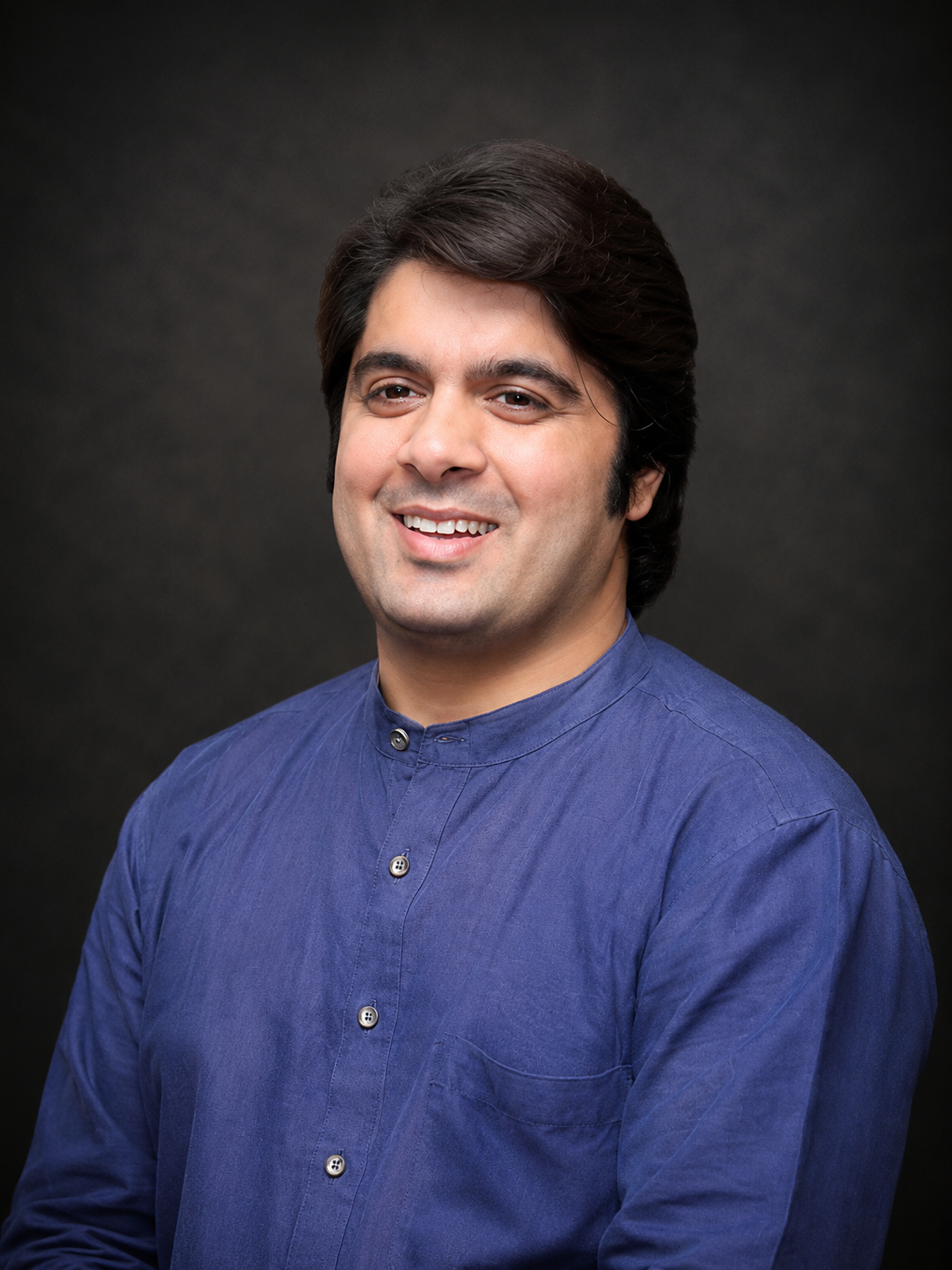
Hazoori Roop Suhina Satguru Baba Narayan Bhajan Sahib is the Seventh Patshahi and present Gaddi Nasheen of Pooj Samadha Ashram, Shikarpur. Entrusted with the sacred Gaddi at the young age of eighteen, Suhina Satguru Sahib continues the spiritual lineage of Samadha with devotion, humility and Seva, guiding the Sangat along the timeless path of Simran, Satsang, Bhakti and selfless service.
Born on 29 January 1990 in Shikarpur, Sindh, Pakistan, Suhina Satguru Sahib was known in his early life as Kelash Samtani, son of Dewan Narain Das Samtani and Mata Deepa N. Samtani. His life entered a new spiritual chapter in 2008, when Sixth Patshahi Satguru Baba Shiv Bhajan Sahib entrusted him with the responsibility of carrying forward the sacred Samadha Gaddi.
Shikarpur has been the spiritual home of the Samadha Parampara for generations. It is here that the sacred Dhuni Sahib has remained at the heart of the Ashram, where generations of Sangat have gathered for Darshan, Satsang, Seva and remembrance of the Divine.
It was in this sacred environment that Suhina Satguru Baba Narayan Bhajan Sahib was born on Monday, 29 January 1990. The biographical record preserved within the Samadha tradition gives his early name as Kelash Samtani and records his parents as Dewan Narain Das Samtani and Mata Deepa N. Samtani.
Few could have known then that, only eighteen years later, he would be called upon to shoulder the responsibility of a spiritual lineage stretching back through generations of Satgurus.
The sacred Gaddi of Samadha is not merely a seat of honour. It represents responsibility: responsibility toward the Satguru Parampara, toward the Ashram, toward the Sangat, toward its maryada and traditions, and above all toward the spiritual path entrusted from one Patshahi to the next. The Ashram’s own account of the lineage describes the Gaddi Nasheen as the spiritual successor entrusted with guiding the Sangat and preserving this continuity.
For Suhina Satguru Sahib, this responsibility arrived at an exceptionally young age.
Within Samadha tradition, the coming of the Seventh Patshahi also carries a deeply cherished spiritual connection with the time of Third Patshahi Satguru Baba Roop Bhajan Sahib.
During Baba Roop Bhajan Sahib’s Patshahi, another devoted saint named Baba Narayan Bhajan Sahib rendered Seva with great dedication. Ashram tradition remembers that he was entrusted with the care of a small Ashram and lovingly served visitors, including by preparing prasad for those who came there.
Although the Gaddi was eventually entrusted to another successor, the tradition preserves a beautiful bachan of Baba Roop Bhajan Sahib to Baba Narayan Bhajan Sahib: that the responsibility which was not his at that time would come to him in a future birth.
For the Sangat, this account occupies a special place in the spiritual memory of Samadha. The advent of the Seventh Patshahi and the conferring of the name Narayan Bhajan Sahib are therefore remembered in the light of a sacred connection extending across generations.
It is one of the many ways in which the history of Samadha is experienced by the Sangat not simply as a sequence of dates, but as a continuing spiritual Parampara in which the grace and bachans of the Satgurus remain alive.
The decisive moment came during the final days of Sixth Patshahi Satguru Baba Shiv Bhajan Sahib.
In February 2008, Baba Shiv Bhajan Sahib travelled to Pune, India, for medical care and Darshan with devotees. According to the Ashram’s preserved history, during this period Sain Baba conveyed his clear wish regarding the future of the Samadha Gaddi. He instructed that Kelash Samtani, son of Dewan Narain Das Samtani, should be honoured as the Seventh Gaddi Nasheen and receive the name Swami Baba Narayan Bhajan Sahib.
This was a moment of profound significance.
The Sixth Patshahi, under whose guidance the Samadha tradition had been carried through many decades of spiritual and institutional growth, had chosen a young successor to preserve that sacred responsibility for another generation.
Satguru Baba Shiv Bhajan Sahib entered Mahasamadhi on 18 March 2008. His departure brought an extraordinary period in the history of Samadha to its close, but the succession he had ordained ensured that the spiritual continuity of the Gaddi remained unbroken.
In accordance with the wish of Satguru Baba Shiv Bhajan Sahib, Kelash Samtani was formally consecrated on 2 April 2008 as Satguru Swami Baba Narayan Bhajan Sahib, the Seventh Patshahi and Gaddi Nasheen of Pooj Samadha Ashram.
The ceremony was held in the presence of respected saints and members of the Sangat from Pakistan and India. The Ashram’s historical account records among those present Sain Sadhram Sahib, Sain Chandu Ram of Lucknow and Sain Kundan Gir Maharaj of Jacobabad, along with other revered saints and devotees.
Suhina Satguru Sahib was only eighteen years old.
At an age when most young people are only beginning to determine the direction of their lives, he was called upon to accept a responsibility extending far beyond himself.
The sacred Gaddi carried the memory of the preceding Satgurus, the expectations and love of the Sangat, the preservation of Ashram maryada and the duty of maintaining a living spiritual tradition across changing times.
From that day onward, his life became inseparable from the Seva of the Gaddi and the Sangat.
The Seventh Patshahi
With the Gaddi ceremony of 2008 began the Seventh Patshahi of Pooj Samadha Ashram.
Suhina Satguru Baba Narayan Bhajan Sahib today serves as the present Gaddi Nasheen, carrying forward the spiritual Parampara through which six preceding Satgurus served generations of devotees. The official Ashram lineage records the Seventh Patshahi as extending from 2008 to the present.
Every Patshahi has unfolded in its own historical circumstances.
The earliest Satgurus served in an age when the Sangat was concentrated primarily around Shikarpur and neighbouring regions. Over generations, communities connected with Samadha spread across Sindh and other parts of Pakistan and, following historical migrations, across numerous cities of India.
The Seventh Patshahi therefore serves a Sangat that extends well beyond the walls of the original Ashram.
Today the Samadha tradition is represented by Ashrams and Dhams in different cities of Pakistan and India, while the historic Pooj Samadha Ashram at Shikarpur remains the spiritual heart of the lineage. The Ashram describes Suhina Satguru Sahib as guiding devotees across both countries with love, devotion and Seva.
Yet across these changing circumstances, the foundation remains the same:
Bhakti.
Simran.
Satsang.
Seva.
Faith in the Satguru.
And remembrance of the One Divine.
A defining emphasis of Suhina Satguru Baba Narayan Bhajan Sahib’s spiritual message is the importance of Seva, Simran and Satsang.
These are not presented as separate aspects of spiritual life, but as practices that strengthen and complete one another.
Simran turns the mind toward the Divine.
Satsang places the seeker in an atmosphere of remembrance, wisdom and Bhakti.
Seva transforms devotion into action.
This message was expressed publicly during Suhina Satguru Sahib’s visit to the Sadhu Vaswani Mission in Pune on 15 December 2022. During the evening Satsang, he spoke about the role of saints in bringing seekers closer to God and emphasized that Seva, Simran and participation in Satsang help the devotee move closer to the Divine and fulfil the purpose of human birth.
This simple teaching carries profound meaning.
Spirituality is not confined to the moments in which one sits in prayer. The remembrance cultivated through Simran must enter everyday conduct. What is heard in Satsang must gradually shape the way one thinks and lives. And love for the Divine must find expression through Seva.
In this way, spiritual life becomes practical.
To serve another person becomes Seva.
To remember the Divine amid worldly responsibilities becomes Simran.
To keep the company of spiritual wisdom becomes Satsang.
And through each of these, the devotee is continually brought back toward the purpose of human life.
The Samadha Parampara has always placed exceptional importance upon selfless Seva.
Under the Seventh Patshahi, this message continues to be given directly to the Sangat. Contemporary teachings published by the Ashram repeatedly return to the importance of Seva, and the Ashram’s own media archive records Suhina Satguru Sahib asking devotees to regard Seva at the Ashram as a precious offering.
Seva in the Samadha tradition is not measured merely by the scale of an act.
A devotee may serve through physical work, by helping another person, by contributing time, by supporting a sacred gathering, by feeding others, by caring for the Ashram or simply by performing an unnoticed duty with sincerity.
What gives the act spiritual value is the bhav with which it is performed.
When Seva is performed without pride and without expectation of recognition, work itself becomes worship.
This is why the Satguru continually turns the devotee from “What can I receive?” toward “How can I serve?”
It is a movement from self-interest toward surrender.
From ego toward humility.
From possession toward contribution.
And from mere belief toward lived Dharma.
The relationship between the Satguru and the Sangat occupies a central place in Samadha tradition.
The Satguru is not distant from the lives of devotees. The Gaddi carries the responsibility of listening, guiding, blessing, correcting, encouraging and keeping the Sangat connected with its spiritual foundation.
Under the Seventh Patshahi, devotees continue to gather around Suhina Satguru Sahib during Satsangs, sacred observances, Janam Utsavs and other Ashram occasions.
His Sandesh frequently addresses the circumstances of ordinary life—faith, relationships, suffering, service, remembrance and the devotee’s connection with the Satguru.
One Sandesh published by the Ashram in July 2026 expresses this relationship in simple words:
“SatGuru ki rehmat har shish par hoti hai. Kisi par zahiri tor par tou kisi par rohani tor par.”
The teaching reminds the Sangat that the grace of the Satguru is not always experienced in the same outward form. At times it may be visible in one’s circumstances; at other times its work may be inward and spiritual.
Such teachings bring spiritual understanding into the emotional realities of everyday life.
At the heart of the wider Samadha tradition stands a simple and universal spiritual understanding:
The official history of the Satguru Parampara preserves this as a central teaching of the tradition.
The teaching carries with it an ethic of humility.
Different people may worship in different ways. They may belong to different communities, speak different languages or live in different lands. Yet the Divine Source remains One.
The spiritual task is therefore not to elevate oneself above another, but to purify one’s own heart.
To serve.
To remember.
To love.
To become humble.
And to recognize the same Divine presence beyond the boundaries created by human beings.
This understanding has helped shape the inclusive spiritual character for which the Samadha tradition has long been remembered.
Suhina Satguru Sahib’s spiritual life also reflects a tradition of respect and fellowship with other saints and spiritual institutions.
A documented example came during his 2022 India Yatra, when he visited the headquarters of the Sadhu Vaswani Mission in Pune. It was his first visit to the Mission. He first paid homage at its Sacred Samadhi and then joined the evening Satsang.
During the gathering, he met Didi Krishna Kumari, exchanged traditional honours and addressed the assembled devotees.
Speaking there, Suhina Satguru Sahib recalled the spiritual connection of his own Guru with Dada Vaswani and expressed his joy at being present at the Mission. He then spoke about saints as guides who bring human beings nearer to God and emphasized Seva, Simran and Satsang as means of drawing closer to the Divine. At the conclusion of his visit, he extended an invitation to the Mission’s devotees to visit the Shikarpur centre.
Such meetings reflect the spirit of mutual reverence that has long existed within the wider Sant tradition: honouring spiritual seekers and saints beyond institutional boundaries while remaining rooted in one’s own Parampara.
The Seventh Patshahi belongs to a period unlike that of any previous Satguru.
The world in which the first Patshahis served and the world of today are separated not only by centuries, but by extraordinary changes in travel, technology, communication and social life.
The Sangat is now geographically dispersed.
A devotee may live hundreds or thousands of kilometres from Shikarpur and yet remain connected with the Ashram.
Satsangs and Sandesh can reach devotees through digital media.
Bhajans and spiritual discourses can be heard far beyond the physical boundaries of a Darbar.
Ashrams in different cities maintain connections with one another and with the original Samadha Gaddi.
The responsibility of the present Patshahi is therefore both ancient and contemporary: to carry the same spiritual foundation into circumstances the earlier Satgurus could never have encountered.
The methods through which the Sangat remains connected may change.
The essence does not.
The Dhuni Sahib remains sacred.
The Satguru Parampara continues.
Satsang continues.
Seva continues.
Simran continues.
The Sangat continues to gather.
And the prayer of Jai Samadha continues from one generation to the next.
The presence of a Hazir Satguru gives a spiritual lineage a living centre.
The earlier Satgurus remain eternally revered through their teachings, lives, Samadhis and the sacred memory of the Sangat. The present Gaddi Nasheen carries the responsibility of preserving that inheritance while guiding those who are living today.
For the Sangat, therefore, Suhina Satguru Baba Narayan Bhajan Sahib represents both continuity and living guidance.
Through him, the Seventh Patshahi remains connected with the Sixth.
The Sixth with the Fifth.
And through the uninterrupted succession of the Gaddi, the present remains connected with the beginnings of the Samadha tradition.
It is this continuity that gives the term Parampara its deeper meaning.
A tradition survives not merely because its history is remembered, but because its values continue to be lived.
The life of Suhina Satguru Baba Narayan Bhajan Sahib cannot be understood simply through the circumstances of his birth or the date on which he received the Gaddi.
Its defining feature is the responsibility that began at eighteen years of age.
From the moment the sacred Gaddi was entrusted to him in 2008, the course of his life became bound to the service of the Satguru Parampara and the Sangat.
Years have passed since that young successor first assumed the Gaddi, yet the essential duty remains what it was at the beginning:
to preserve what was entrusted,
to guide those who seek,
to keep the Sangat connected,
to encourage Seva,
to awaken Simran,
to sustain Satsang,
and to carry the spiritual light received from the preceding Satgurus into another generation.
Today, Hazoori Roop Suhina Satguru Baba Narayan Bhajan Sahib continues to grace the sacred Gaddi as the Seventh Patshahi and present Gaddi Nasheen of Pooj Samadha Ashram, Shikarpur.
His Patshahi forms the living chapter of a spiritual history that began generations before him and continues through the devotion of the Sangat today.
The message remains simple.
Remember the Divine.
Keep the company of Satsang.
Perform Seva without ego.
Remain humble.
Have faith.
Recognize the One Divine in all.
And make this precious human life meaningful through devotion and service.
The world around the Ashram may continue to change, but these spiritual foundations remain timeless.
The sacred Dhuni continues to burn.
The Sangat continues to gather.
The Satguru Parampara continues to guide.
And the light entrusted from one Patshahi to another continues under the sacred Gaddi of Suhina Satguru Baba Narayan Bhajan Sahib.
THE SACRED LINEAGE

For IOS and IPAD browsers, Install PWA using add to home screen in ios safari browser or add to dock option in macos safari browser