
About Us
Ashrams
Pakistan
Sant Satguru
Events
Satguru Warsi Utsavs
Satguru Janam Utsavs
Special Ashram Observances
Dharmic Festivals
Pakistan
Satguru Warsi Utsavs
Satguru Janam Utsavs
Special Ashram Observances
Dharmic Festivals
The Fifth Patshahi (1881–1951)
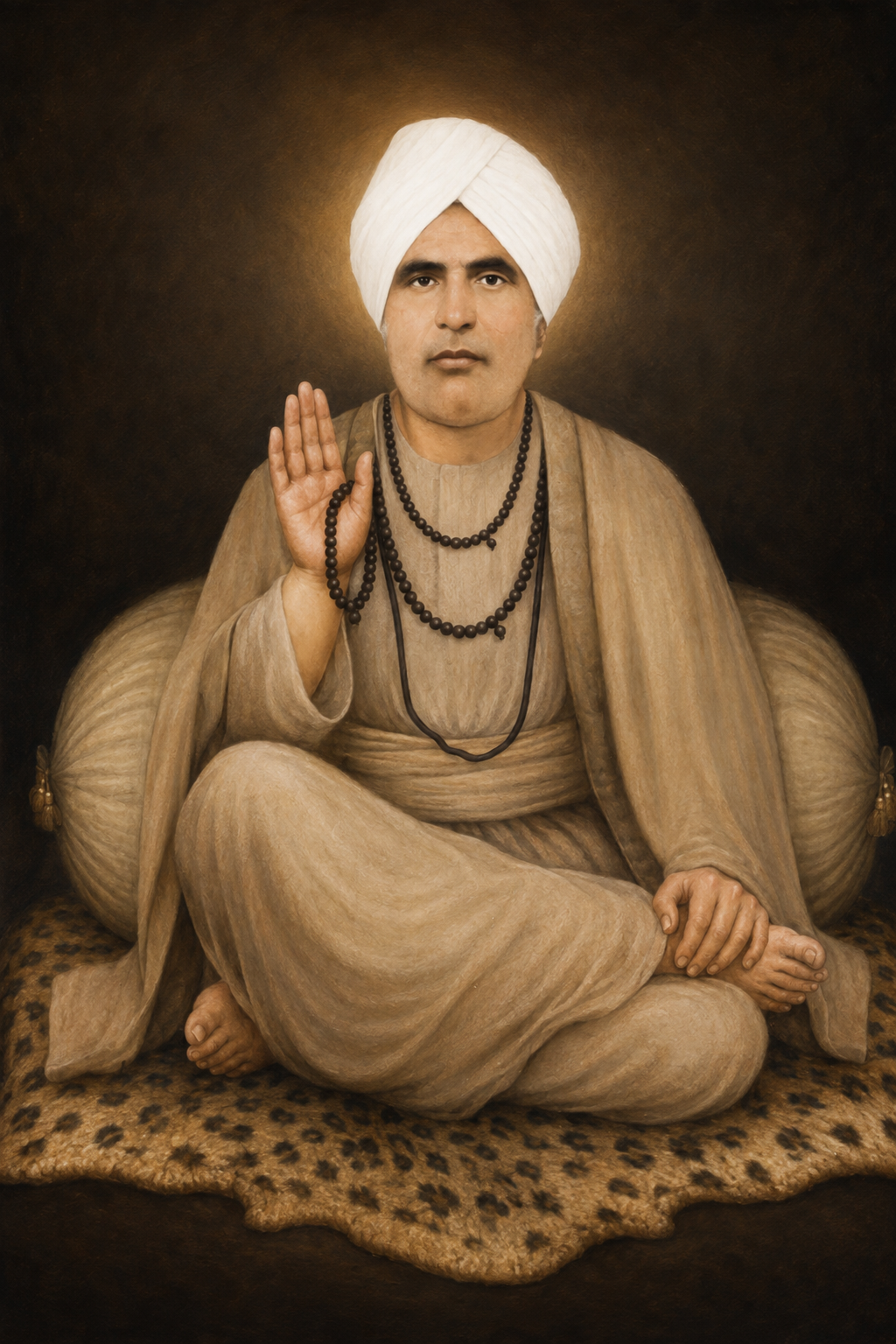
There is a sacred time just before sunrise, known as Amrit Vela, when the world is draped in absolute silence and the veil between the physical and the divine is at its thinnest. In the year 1881, during these deeply blessed hours, a radiant soul incarnated in Shikarpur.
When his parents, Dewan Veeru Mal and his devoted wife, first gazed upon their child, they were mesmerized by a mysterious, luminous glow emanating from his face. Recognizing the divine light within him, they joyously named him Lakheney Laal (The Lucky Child) and distributed clothes and sweets to the poor. Yet, Dewan Veeru Mal, a dedicated follower of Samadha Ashram, felt an immediate calling to present this radiant soul to his Satguru.
Dewan Veeru Mal carried the infant to Samadha Ashram and placed him gently into the arms of the Second Gaddi Nasheen, Satguru Baba Ram Bhajan Sahib. Until that exact moment, the child had been utterly silent. But as he rested in the Satguru’s arms, he suddenly let out a strong, clear vocalization.
Satguru Baba Ram Bhajan Sahib smiled with profound recognition and delivered a momentous prophecy to the Sangat: “He has announced his arrival. Listen carefully—he is not an ordinary child. He will not only become a great saint, but he will be the successor of Samadha Ashram in the future.” Later, the child would be formally initiated into the Divine Name (Naam) by Baba Kishan Bhajan Sahib, who bestowed upon him the sacred name Baba Gobind Bhajan.
As his physical vessel matured in the divine atmosphere of Samadha Ashram, Baba Gobind Bhajan naturally gravitated toward deep silence and prayer, remaining entirely detached from worldly play. When he ascended to the sacred seat as the Fifth Patshahi in 1929, the Sangat marveled at the profound depth of his quietude. When he recited from the Guru Granth Sahib, his voice was so extraordinarily soft that even the sevadar waving the chaur sahib (peacock feather whisk) right beside him could barely hear the words.
This silence was not a worldly trait, but the manifestation of the highest yogic state. Satguru Baba Gobind Bhajan Sahib had completely transcended the initial stages of devotion, reaching the supreme fourth level of consciousness. In this exalted state, all worldly dualities dissolve—he saw no difference between day and night, hot and cold, praise and insult, joy and sorrow. Every moment, every breath, and every sight was simply the Divine. He did not need to speak loudly, for his mere physical presence radiated a silence that instantly calmed troubled hearts.
While his predecessor, Baba Kishan Bhajan Sahib, had been a brilliant and captivating orator, Baba Gobind Bhajan Sahib was the quiet, devoted laborer of love. He saw no distinction between deep meditation and physical work. His profound divine bliss manifested vividly in the Ashram’s garden, where he could frequently be found with soil on his hands, tending the plants with the tender love of a mother caring for her children.
During the sacred gatherings on Green Sundays, the Satguru would personally cook the bhandara (community meal) for the Sangat. Kings and sweepers, Hindus and Muslims, the wealthy and the destitute—all sat together on the ground to eat the food prepared by his own hands. He often taught that a saint endures physical labor joyfully, comparing it to the legendary Sassi walking barefoot over jagged mountains to reach her beloved Punnu. The physical effort is experienced as pure bliss because every step is a step toward the Divine.
When the subcontinent was partitioned in 1947, an era of profound fear and uncertainty swept through Sindh. Many revered saints and spiritual leaders migrated to India.
Yet, Satguru Baba Gobind Bhajan Sahib remained utterly unmoved by the worldly chaos. He chose to stay in Shikarpur. For him, Samadha Ashram belonged to no single religion or nation; it was a sanctuary for all of humanity. Supported by his divine companion, Swami Parmanand Shankar Bharti, the Satguru kept the doors of the Ashram open, proving to the world that divine love and selfless service are infinitely more powerful than human division.
During this turbulent time, countless families prepared to leave their ancestral homes. Dewan Thakur Das—the very man who had been promised five sons by the Fourth Patshahi—came with his wife to seek Baba Gobind Bhajan Sahib’s final blessings before migrating to India.
When they arrived, the Satguru was deeply immersed in meditation, surrounded by rose petals. Without opening his eyes, he gathered a handful of petals and placed them directly into Dewan Thakur Das’s jholi (lap). Breaking his silence, the Satguru commanded: “Do not leave our country. Stay in Pakistan with us. Samadha Ashram will always protect and support your family.” Recognizing the absolute authority of his Master, Dewan Thakur Das canceled his departure.
This divine intervention orchestrated a cosmic fulfillment. By commanding the family to stay, Baba Gobind Bhajan Sahib ensured that Dewan Thakur Das’s son—the reincarnated soul of Baba Kishan Bhajan Sahib—would remain rooted in the sacred soil of Shikarpur to eventually become the Sixth Satguru.
The Satguru held deep reverence for all true seekers of the Divine. Once, during the annual celebration honoring the Third Patshahi, the legendary devotional singer Bhagat Kanwar Ram Sahib arrived at Samadha Ashram. Baba Gobind Bhajan Sahib, who rarely broke his seated meditation, did something extraordinary: he stood up to welcome the singer, demonstrating the ultimate respect a Satguru holds for genuine devotion.
Bhagat Kanwar Ram’s soul-stirring rendition of “Naaley Alakh Jay Bero Taar Mohin jo” brought tears of divine ecstasy to the eyes of the entire Sangat. As the beloved singer departed, he was honored with a Pakhar—a blessed shawl that had touched the Guru Granth Sahib—sealing a beautiful moment of divine communion.
As the year 1951 approached, Satguru Baba Gobind Bhajan Sahib knew it was time to prepare for his conscious withdrawal from the physical realm. He often explained the supreme nature of the Guru-disciple relationship to the Sangat: “A Satguru is more precious than the Paras stone. The Paras stone can turn iron into gold, but it cannot turn iron into another Paras stone. However, when a Satguru bestows his grace, the disciple becomes the Satguru himself, carrying the exact same divine light.”
On October 8, 1951, the Satguru formally declared his spiritual will. A stamp vendor was summoned, and the Satguru officially appointed Shewa Ram—one of Dewan Thakur Das’s five sons—as the Sixth Gaddi Nasheen, bestowing upon him the name Satguru Baba Shiv Bhajan Sahib. Fulfilling the ancient promise of the Fourth Patshahi, the Satguru joyously declared to the Sangat: “There is no difference between me and Baba Shiv Bhajan Sahib. We are the exact same soul in two different bodies.”
Shortly after securing the lineage, Satguru Baba Gobind Bhajan Sahib voluntarily manifested a severe fever in his physical form as part of his final divine play. Baba Shiv Bhajan Sahib personally brought Dr. Farooqi to attend to the physical vessel, but the Satguru, resting in absolute transcendental peace, simply smiled. “Now our boat is ready to leave,” he whispered.
On October 27, 1951—the sacred day of Ashtami in the Kut month (Vikram Samvat 2008)—Satguru Baba Gobind Bhajan Sahib consciously cast off his physical garment and entered Maha Samadhi.
When the news spread, the entire city of Shikarpur came to a standstill. Markets closed, and citizens of every faith gathered to honor the silent master who had loved them unconditionally. Following his divine will, his sacred Maha Samadhi ceremonies were held at the Sindh Canal. A grand assembly of enlightened souls, including Swami Harnam Das Udaseen, Swami Parmanand Shankar Bharti, Swami Arjan Das Masand, and Bhai Chatru Ram Sahib, gathered to witness the young Baba Shiv Bhajan Sahib perform the sacred rites for his spiritual father.
Today, decades later, the silent power of Satguru Baba Gobind Bhajan Sahib continues to permeate Samadha Ashram, reminding every seeker that the deepest devotion is often the most quiet, and the truest love requires no words at all.
THE SACRED LINEAGE

For IOS and IPAD browsers, Install PWA using add to home screen in ios safari browser or add to dock option in macos safari browser